The Real China: Beyond the Old Movies
I know what you might picture when you think of China.
Maybe it's the grainy black-and-white footage of crowds in grey Mao suits riding bicycles. Maybe it's the straw-hatted farmers from old kung fu movies. Or perhaps it's the stern, smoggy cityscapes shown in some Western media. For decades, these images have stuck in people's minds like faded photographs, taken as the whole truth.
If you stood on a street corner in Beijing or Shanghai right now, you'd see that those days are long gone. Everything you thought China didn't have — it's been happening here, every single day.
Let's start with what people wear
Walk through Taikoo Li in Chengdu or Mixc World in Shenzhen, and the young crowd dresses almost identically to their peers in London, New York, or Tokyo. Limited-edition Nikes or Li-Ning sneakers on their feet. Uniqlo basics or pieces by local independent designers. The only difference? You might spot some girls wearing modernized Hanfu — traditional Chinese clothing — or a qipao, heading out for afternoon tea. They're not filming a period drama. That's just their weekend outfit.
Even a decade ago, this "Hanfu revival" would have raised eyebrows among the older generation. Now, it's as normal as throwing on a hoodie. Young Chinese aren't just following global fashion trends — they're digging into their own heritage, printing thousand-year-old patterns onto today's T-shirts.
You won't need cash or cards. Seriously.
This might be the single biggest shock when you land in China: almost nobody uses cash or credit cards anymore. From buying a roasted sweet potato for two yuan from a roadside cart to purchasing a laptop in a shopping mall, everything is paid for by scanning a QR code with your phone. WeChat Pay and Alipay cover the entire country, even the most remote villages. I just got back from a tiny mountain hamlet in Yunnan, and the old woman selling honey by the roadside had a payment QR code propped up next to her jars. Her grandson set it up for her, she said.
And the food itself — if you think Chinese food is all Kung Pao chicken and spring rolls, you really need to come here. Beijing's bubbling copper hot pot with paper-thin lamb slices. Chengdu's fiery cauldrons of red oil soup dancing with Sichuan peppercorns. Guangzhou's dim sum restaurants still buzzing at 3 a.m. Xi'an's Muslim Quarter, where they tear flatbread into mutton soup. Xinjiang's big-plate chicken, the flat noodles soaked in rich, spicy gravy. A Chinese person could spend an entire lifetime eating their way across their own country and still never finish.
Oh, and if you're craving coffee? The density of specialty coffee shops in Shanghai probably exceeds that of some Italian cities now. Down in Yunnan province, they've even started growing their own coffee beans, and the quality has made international judges do a double-take.
Homes: Old and new, growing together
Many people still imagine Chinese people living in drab, Soviet-style apartment blocks. The reality? Most city residential compounds are planned like parks, with gardens, running tracks, and swimming pools. In Hangzhou or Suzhou, some young people are choosing to renovate old houses in the historic lanes — cobblestone alleys outside, floor-to-ceiling glass windows inside.
Yes, housing is not cheap, and young people work hard to afford a down payment — not so different from their counterparts in New York, London, or Sydney. What's changing is that more and more of them are choosing to rent instead, spending their money on travel, learning, and experiences rather than tying themselves down to a mortgage.
Getting around: Bullet trains and silent scooters
You've probably heard of China's high-speed rail. Think Japan's Shinkansen, but with an even denser network. The trip from Beijing to Shanghai — roughly the same distance as London to Rome — takes just four and a half hours, and the trains are so punctual it almost hurts.
[Image: A sleek high-speed train pulling into a modern, sunlight-filled station, the platform clean and orderly, passengers lined up calmly.]
Inside cities, the metro systems are sprawling, efficient, and impossibly clean. And on the streets? You'll notice something else: electric vehicles everywhere. Not just electric cars — China is now the world's largest EV market — but electric scooters, zipping past in near silence. Many city buses are electric too, gliding quietly past you. The ringing of a billion bicycle bells thirty years ago has transformed into the soft hum of an electric fleet.
But what I really want to tell you about is the people
You can't capture the real China just by photographing its buildings and gadgets. I want you to see the people:
Early morning in a city park: a group of retired folks practicing tai chi. Not for tourists. It's just their decades-long routine. In the next open space, their grandkids are learning tricks on skateboards.
Eight o'clock in the evening: music suddenly blasts from a public square, and dozens of aunties launch into a synchronized dance. They don't care if the steps look elegant. They care about joy, about being together with their friends.
I also want you to meet the man who runs the convenience store below my apartment. He remembers every regular customer's habits. At three in the morning, he's still there, heating up a bento box for someone coming home from overtime. And I want you to meet the primary school teacher I encountered deep in the Sichuan mountains. She gave up a job in the city and has stayed there for fifteen years. "Every child deserves a chance to see a bigger world," she said.
Chinese people are pragmatic. They're hardworking. But they're also funny, and they're warm. You might find yourself laughing at the heated banter of old men playing Chinese chess on the curb, spectators crowding around and shouting advice. You might get lost and have a kind auntie insist on walking you all the way to your destination.
[Image: A candid street shot: a group of men hunched over a Chinese chess board on a small stool, expressions intense, evening light, a cup of tea placed next to them.]
Come and see for yourself
I've been writing about China for thirty years, and I believe one thing more strongly than ever: when it comes to China, you have to come and see it with your own eyes to truly understand it. It's not a symbol. It's not a news headline. It's a place with 1.4 billion individual stories.
It's not perfect. It has its own tough problems to solve. But the people here, in their own ways, are making their lives good — and making them full of flavor.
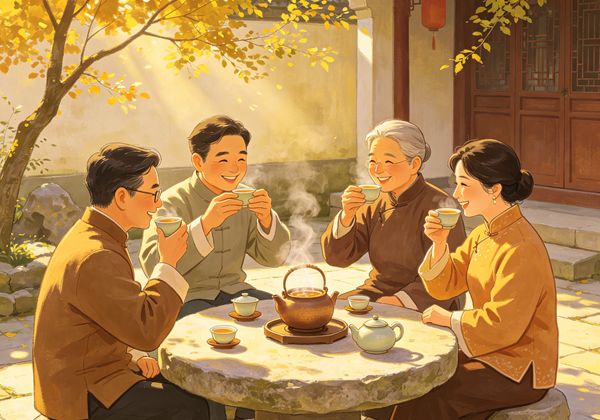
So, if you ever get the chance, come. Eat a real hot pot. Ride a high-speed train through the rice paddies of the Yangtze delta. Have a cup of tea in a Chinese friend's home. Wander the streets and breathe in the scent of Sichuan pepper and cinnamon.
This country will find its way into your memory in the most unexpected way.
You're very welcome to come and explore. What you see with your own eyes — that's the real thing.
Login to join the discussion.